







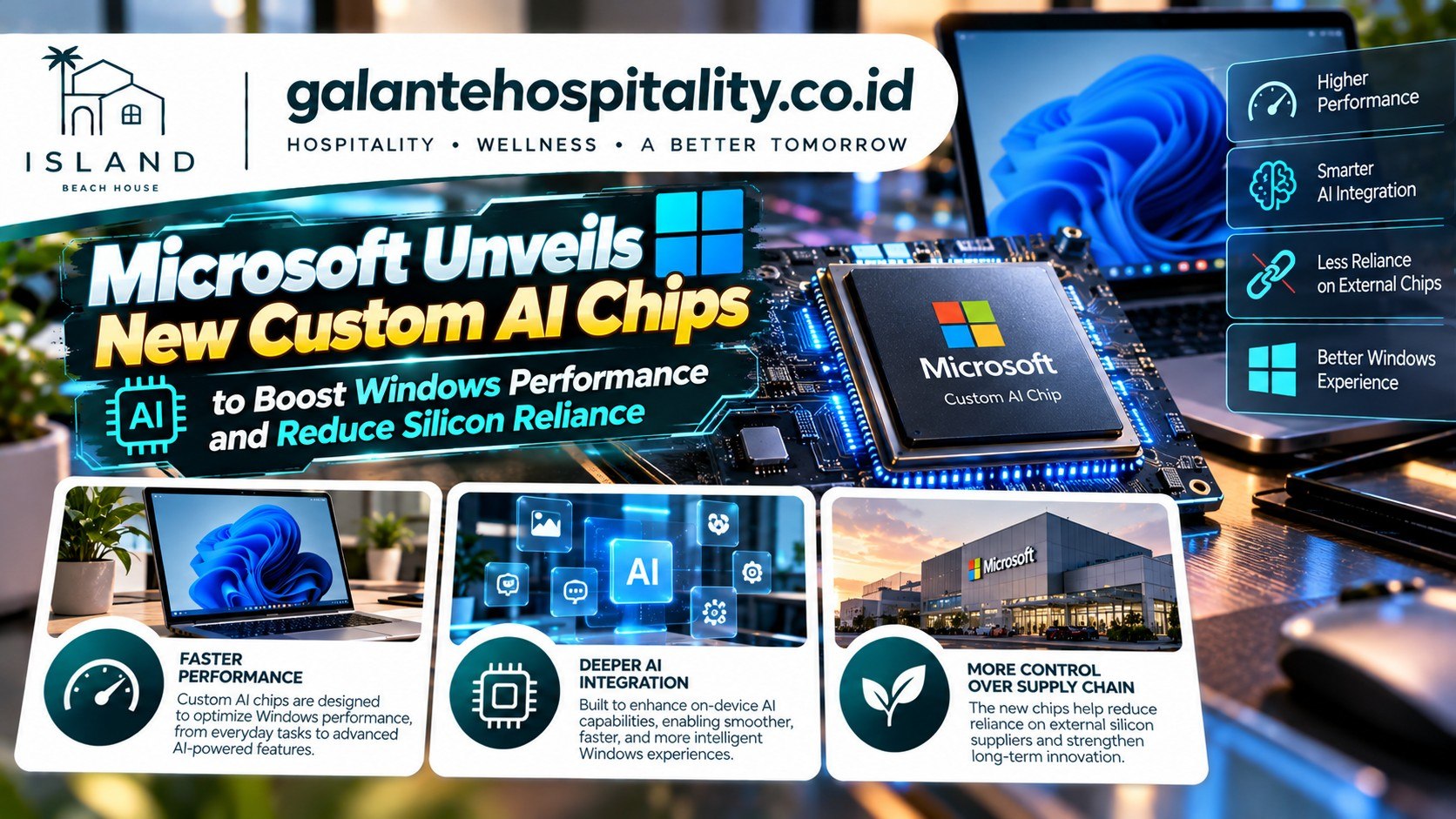

Microsoft is expanding its custom silicon strategy as demand for artificial intelligence continues to reshape the technology industry. The company’s latest Maia processor development reflects an effort to improve the performance and efficiency of AI workloads while reducing dependence on external accelerator suppliers.
On October 12, 2026, Microsoft announced Maia 300, its third-generation custom AI chip. The processor is designed primarily for AI inference across Microsoft’s products and services, with large-scale deployment planned to begin in 2027.
Although the announcement is closely connected to the future of Windows and AI-powered computing, Maia 300 is not simply a conventional Windows performance chip. Its main role is to support the computing infrastructure behind AI services, including workloads that help power intelligent assistants and other cloud-based applications.
Why Microsoft Is Developing Its Own AI Chips
AI services require substantial processing capacity to generate responses, analyze information, and execute increasingly complex tasks. As usage expands, the cost of operating these systems becomes an important consideration for technology companies.
Developing custom processors gives Microsoft greater control over how its hardware is designed around its own software and infrastructure requirements.
Rather than relying entirely on commercially available accelerators, the company can optimize processor architecture, memory systems, networking, and server configurations for particular workloads.
This strategy may improve operating efficiency and provide greater flexibility when planning data center capacity. It also allows Microsoft to tailor hardware development to the needs of its cloud services and AI applications.
However, custom silicon does not eliminate the need for external chip suppliers. Manufacturing advanced processors still depends on specialized semiconductor production, packaging technologies, and a complex global supply chain.
Maia 300 Targets More Efficient AI Processing
Microsoft has positioned Maia 300 as a major step in improving the efficiency of AI inference. According to the company, the new processor is expected to deliver approximately 40% more useful AI computing output per megawatt than leading GPU-based systems used for comparison.
The company has also described improvements in rack-scale throughput, with a full configuration of 96 accelerators expected to provide substantially higher throughput than its predecessor.
These figures are company-reported performance targets and comparisons. Actual results can vary depending on the workload, model architecture, software configuration, and measurement methodology.
The processor uses a chiplet-based design, which combines specialized silicon components into a larger computing system. This approach allows different functions to be optimized for their particular requirements rather than placing every component on a single large chip.
Such architectural choices can influence manufacturing efficiency, power consumption, and the performance of large AI systems.
How Custom Chips Could Support Windows AI Features
Microsoft is increasingly developing Windows as a platform for hybrid intelligence, where AI tasks can be processed locally on a device or remotely through cloud infrastructure.
This approach allows different workloads to run where they are most appropriate. Smaller or privacy-sensitive tasks may be handled locally when compatible hardware and software are available, while more demanding operations can use cloud-based models.
Custom AI chips in data centers can support cloud services used by Windows applications. Meanwhile, local processors and dedicated neural processing units can help compatible PCs run certain AI features directly on the device.
The distinction is important because Maia 300 is primarily a data center accelerator rather than a chip installed in ordinary consumer laptops. Its benefits for Windows users are therefore expected to be indirect, through the performance and efficiency of Microsoft’s AI services.
Local AI processing and cloud-based AI computing serve complementary roles in the company’s broader strategy.
Reducing Dependence on External Chip Suppliers
Major cloud providers are increasingly developing specialized processors to gain greater control over infrastructure costs and performance.
Microsoft’s strategy reflects this wider trend. Building custom silicon may help the company reduce its dependence on third-party accelerators for selected workloads, although it will continue to operate a diverse hardware ecosystem.
A broader selection of processors can also give engineers more options when matching workloads to hardware. Some models may benefit from one accelerator architecture, while other applications may perform better on a different system.
The challenge is ensuring that software tools, programming frameworks, and deployment systems can use the available hardware effectively.
Hardware diversification only delivers meaningful benefits when the supporting software is reliable and the systems can be operated at scale.
Energy Efficiency Becomes a Strategic Priority
AI data centers consume significant amounts of electricity, making energy efficiency increasingly important for infrastructure planning.
Improving the amount of useful computing performed per unit of electricity can help reduce operating costs and ease some pressure on power infrastructure. However, more efficient processors do not automatically reduce total energy consumption if overall demand grows faster than efficiency improves.
Microsoft’s planned expansion of Maia infrastructure will therefore need to be considered alongside data center capacity, cooling systems, power availability, and workload management.
These factors will influence how much value the company ultimately gains from its custom chip investments.
What the Development Means for the Technology Industry
Microsoft’s Maia 300 announcement highlights the growing importance of specialized hardware in the AI market. Software companies are increasingly investing in processors that are designed around their own services rather than relying exclusively on general-purpose computing products.
For Windows users, the most visible benefits may emerge through improvements in cloud-powered AI features, responsiveness, and service availability rather than through a direct hardware upgrade in existing PCs.
For enterprise customers, more efficient infrastructure could support the expansion of AI tools across business applications.
The next major milestone will be the planned production deployment in 2027. Performance under real workloads, manufacturing capacity, software compatibility, and energy efficiency will determine how successful the strategy becomes.
As competition in AI infrastructure intensifies, Microsoft’s custom silicon program represents a long-term investment in controlling more of the technology stack behind its AI products and services.


