







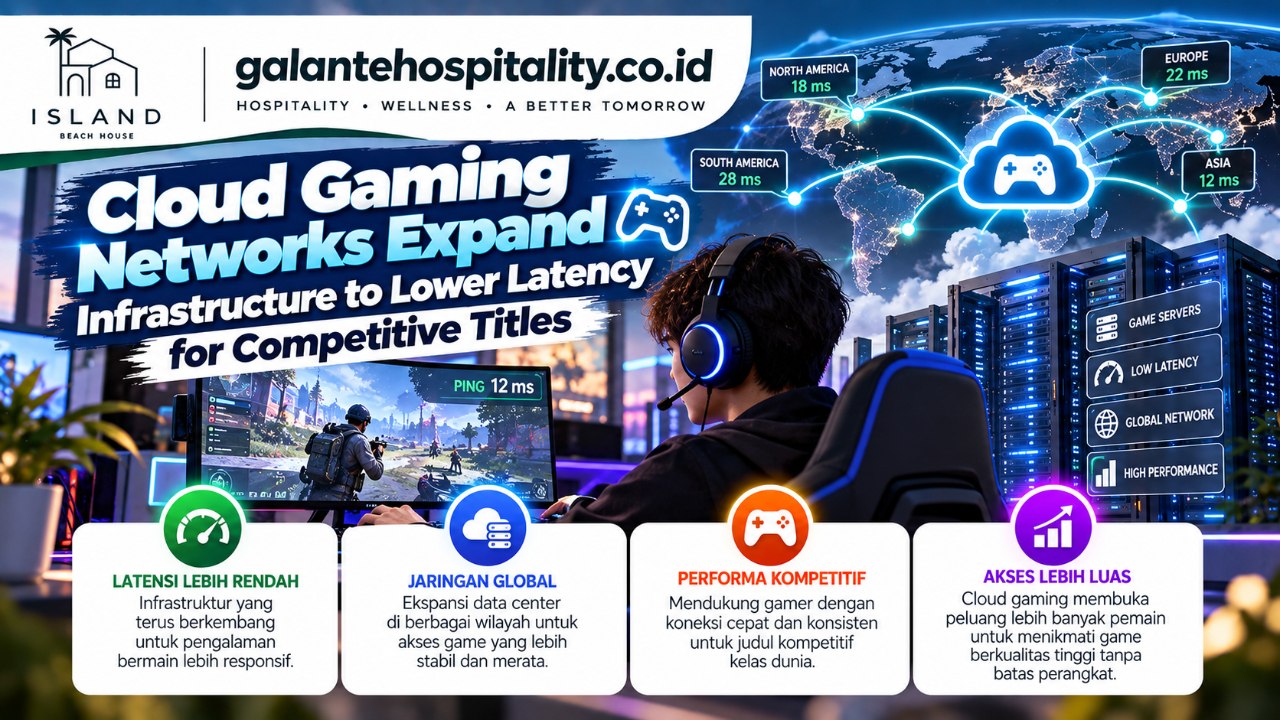

Cloud gaming providers are investing in network infrastructure to improve responsiveness as more players explore streaming-based gaming on computers, smartphones, tablets, and connected televisions. The technology allows games to run on remote servers while video and audio are streamed to users over the internet, reducing the need for powerful local hardware.
This model can make demanding games accessible on devices that would otherwise struggle to run them. Instead of relying entirely on a gaming PC or console, players can use a compatible device to connect to a remote gaming system. The server processes player inputs, renders the game, and transmits the resulting video stream back to the screen.
However, cloud gaming introduces a technical challenge that is particularly important for competitive titles: latency. Latency refers to the delay between a player’s action and the corresponding response appearing in the game. In fast-paced shooters, fighting games, racing competitions, and other reaction-sensitive genres, even relatively small delays can affect the playing experience.
To address this issue, cloud gaming companies are expanding server capacity and improving how their systems connect to internet networks. Placing servers closer to major population centers can reduce the physical distance that data must travel, potentially lowering network latency for users in supported regions.
Network routing also matters. Data does not always follow the most direct physical route between a player and a gaming server. Providers may work with internet service companies, content delivery networks, and data center operators to improve routing efficiency and reduce unnecessary delays.
Another important factor is the performance of the connection between a player’s device and the internet. A geographically nearby server cannot fully compensate for an unstable home network, excessive Wi-Fi interference, or congestion caused by other devices using the same connection.
Cloud gaming services therefore need to address several parts of the delivery process. Server performance, video encoding, network transmission, and client-side decoding all influence the time required to display a response. Improvements in any one area may help, but competitive gaming often requires the entire system to work efficiently.
The expansion of edge computing is one potential solution. Edge infrastructure places computing resources closer to users instead of concentrating every operation in a small number of distant data centers. For cloud gaming, this can shorten data transmission paths and help services respond more quickly to player inputs.
Yet expanding edge infrastructure involves substantial investment. Providers must secure suitable facilities, maintain powerful hardware, establish reliable connectivity, and distribute capacity according to regional demand. Building additional data centers does not automatically guarantee better performance if network routing or local connectivity remains a bottleneck.
The quality of the video stream presents another challenge. Cloud gaming services must transmit detailed images quickly enough to preserve smooth movement and visual clarity. Higher resolutions and frame rates can increase bandwidth requirements, while aggressive compression may introduce visible artifacts.
Adaptive streaming technologies attempt to balance image quality with network conditions. When bandwidth decreases, a service may adjust resolution or encoding settings to maintain continuity. This can prevent interruptions, although the resulting visual changes may be noticeable during demanding gameplay.
For competitive players, consistency is often as important as average latency. Sudden increases in delay, commonly associated with network jitter or congestion, can make controls feel unpredictable. Services that deliver stable performance may therefore offer a better experience than those with impressive average speeds but frequent fluctuations.
Internet service providers remain a crucial part of this equation. Fiber connections and well-managed wired networks can provide reliable performance, while modern Wi-Fi systems may offer suitable results under favorable conditions. Mobile networks can also support cloud gaming, although performance depends on signal quality, congestion, coverage, and network configuration.
Players should recognize that cloud gaming is not equally suitable for every genre or competitive environment. Turn-based games and slower-paced adventures are generally more tolerant of small delays than professional-level competitive shooters or fighting games, where precise timing is essential.
Subscription models and game availability also influence adoption. Some services offer access to a catalog of titles, while others allow users to stream games they already own under specific conditions. Consumers need to review supported devices, regional availability, connection requirements, and pricing before choosing a platform.
Security and account protection are additional considerations as gaming becomes increasingly connected to remote infrastructure. Providers must protect user accounts, payment information, and game-related data while maintaining dependable access to their services.
Despite these challenges, cloud gaming continues to offer an alternative to traditional hardware-based gaming. It can reduce the upfront cost of accessing certain titles, simplify device upgrades, and make gaming more portable. Its appeal will depend on whether providers can deliver a consistent experience across different locations and network conditions.
Continued investment in edge computing, server efficiency, network routing, and video compression could make cloud gaming more responsive over time. However, local hardware will remain important for players who require the lowest possible latency and complete control over their gaming environment.
The future of competitive cloud gaming will depend on more than expanding server capacity. Reliable connectivity, stable frame delivery, responsive input processing, and transparent service requirements must work together. If providers can improve these elements while maintaining affordable access, cloud gaming could become a more practical option for an increasingly broad audience.


