







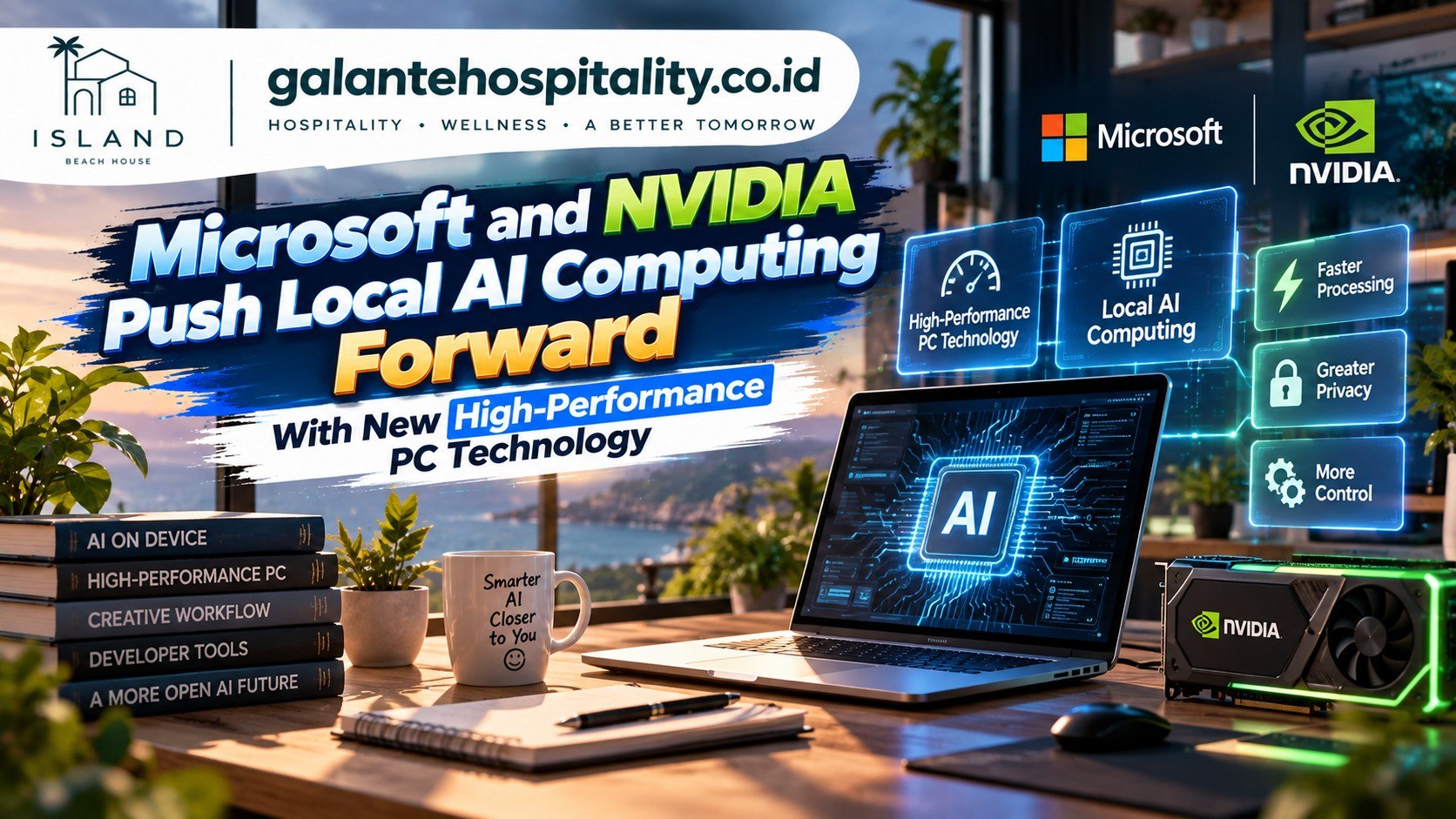

Artificial intelligence is changing the personal computer industry. Instead of relying entirely on remote cloud servers, new computers are being designed to run increasingly demanding AI workloads directly on local hardware.
Microsoft and NVIDIA are among the companies advancing this approach through new PC technology designed for developers, creators, and professionals. Their latest initiatives reflect a broader shift toward personal computers that can support AI assistants, content creation, and complex computing tasks with greater flexibility.
The Rise of Local AI Computing
Local AI computing allows compatible models to process information directly on a computer rather than sending every request to a remote server.
This approach can offer several advantages. Depending on the model and hardware, users may experience lower latency, maintain greater control over sensitive data, and continue using certain AI features without a constant internet connection.
Local processing can also help organizations manage cloud computing expenses. However, running larger models on a personal computer requires substantial memory, processing power, and efficient thermal management.
For this reason, hardware manufacturers are developing systems with dedicated AI accelerators, powerful graphics processors, and larger unified memory capacities.
Microsoft and NVIDIA Expand AI PC Capabilities
On October 7, 2026, Microsoft and NVIDIA highlighted new developments in AI-powered Windows computing, including NVIDIA RTX Spark technology and systems designed to run AI workloads locally. Microsoft also outlined a hybrid approach in which AI tasks can be handled on the device or in the cloud, depending on the requirements. <Cite refs={[“turn803603news66″,”turn803603search8”]}/>
This approach could give users more flexibility. Smaller or privacy-sensitive tasks may be processed locally, while computationally demanding requests can use cloud infrastructure when needed.
For developers, these systems may make it easier to experiment with AI applications without depending entirely on external services. Creative professionals may also benefit from local tools for image generation, video editing, coding assistance, and other demanding workflows.
Why Hardware Performance Matters
AI applications often require more than a conventional processor can efficiently provide. Modern systems may use a combination of central processing units, graphics processing units, and neural processing units to handle different workloads.
Memory is another important consideration. Models must fit into available memory to run efficiently, and larger models can require substantial resources.
High-performance AI computers therefore aim to balance processing speed, memory capacity, power consumption, and cooling. Manufacturers must also ensure that demanding workloads do not significantly compromise battery life or everyday usability.
Although these improvements can expand what personal computers are capable of doing, premium hardware may remain expensive. Users should evaluate their actual workloads before investing in a high-end AI system.
Privacy and Security in the Age of AI PCs
Processing information locally can reduce the need to transmit certain data to remote servers. This may be useful for professionals working with confidential documents, proprietary code, or private business information.
However, local processing does not automatically guarantee security. A compromised device, poorly configured application, or AI agent with excessive permissions can still expose sensitive information.
Microsoft has emphasized the importance of security and control as AI agents become more integrated into Windows environments. Its recent work includes mechanisms intended to help restrict the resources that agents can access. <Cite refs={[“turn803603search8″,”turn803603news66”]}/>
Users should still install security updates, apply appropriate access controls, and review the permissions granted to AI applications.
What This Means for Developers and Businesses
Local AI computing could make AI development more accessible to teams that need to test models, build prototypes, or work with sensitive information.
Businesses may also benefit from hybrid systems that combine local processing with cloud services. This allows organizations to choose the most appropriate environment for each task instead of relying on a single computing model.
Nevertheless, successful adoption requires more than purchasing new hardware. Organizations must consider software compatibility, employee training, maintenance costs, data governance, and security requirements.
For smaller businesses, a standard computer with access to cloud-based AI services may still be more cost-effective than a premium local AI workstation.
The Future of Personal Computers
As AI becomes more integrated into everyday software, personal computers may increasingly function as active assistants rather than passive tools. Users could delegate repetitive tasks, analyze documents, generate content, and manage complex workflows through natural-language instructions.
The challenge will be making these capabilities useful without sacrificing reliability, affordability, or user control.
Microsoft and NVIDIA’s latest developments illustrate how hardware and software are evolving together to support this transition. The next stage of AI computing will likely depend on how effectively manufacturers balance performance with practical everyday needs.
Conclusion
Local AI computing is creating new opportunities for developers, businesses, and everyday computer users. More capable hardware can support advanced applications while offering alternatives to fully cloud-dependent workflows.
However, the best AI PC is not necessarily the most powerful or expensive one. Users should focus on performance, privacy, compatibility, and cost when deciding which technology suits their needs.


