







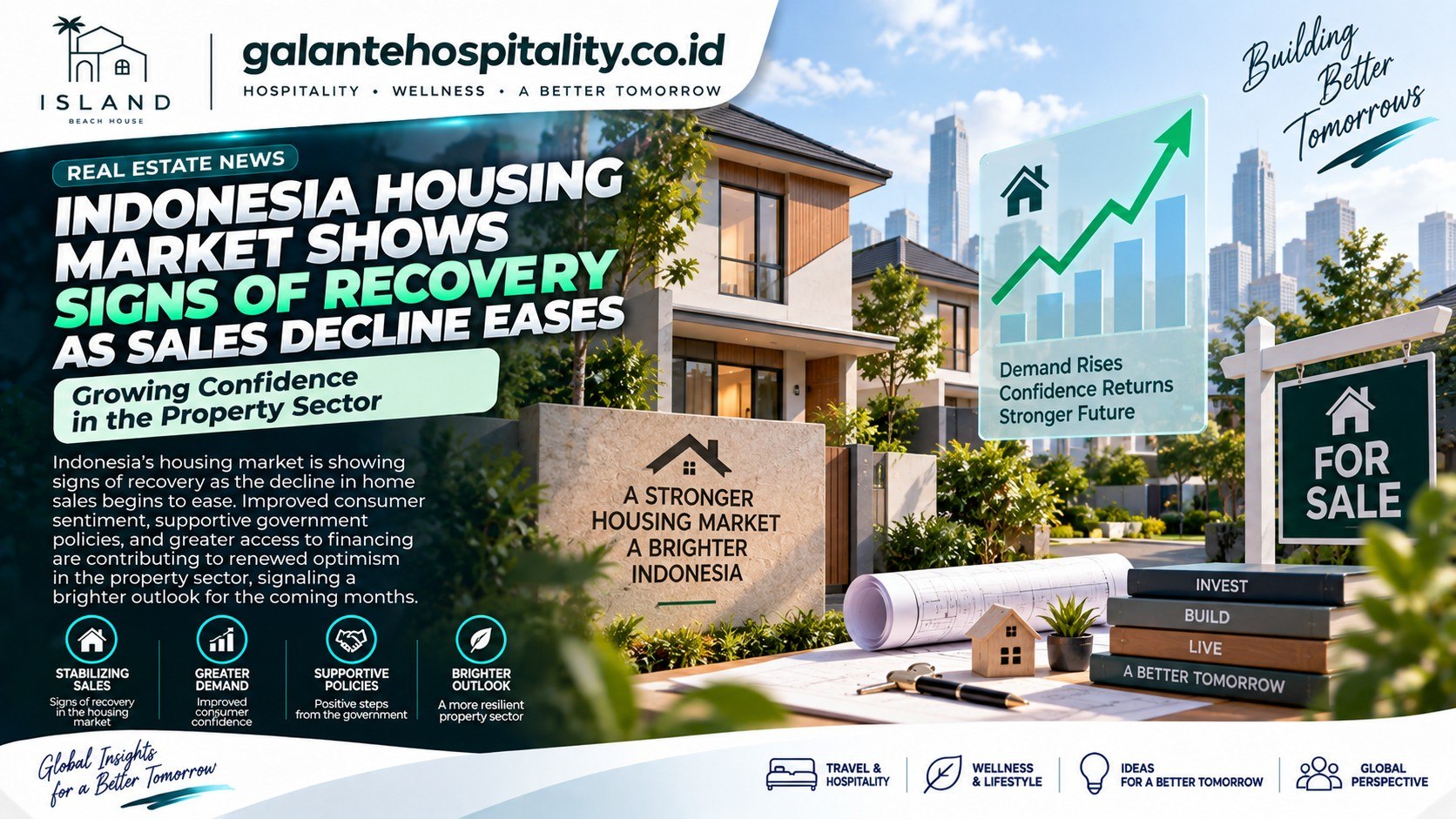

Indonesia’s Residential Property Market Begins to Improve
Indonesia’s residential property market is showing signs of improvement after a sharp slowdown earlier in 2026.
According to Bank Indonesia’s latest Residential Property Price Survey, residential property sales in the primary market contracted by 2.36% year-on-year in the second quarter of 2026. While sales were still in negative territory, the decline was significantly smaller than the 25.67% contraction recorded in the first quarter.
The development indicates that demand for new homes has started to stabilize, although the property market has not yet returned to positive annual growth.
Small and Large Houses Support the Recovery
The improvement in residential sales was mainly supported by stronger sales of small and large housing units.
Bank Indonesia reported that sales of small residential properties improved during the second quarter, while demand for medium-sized homes remained relatively limited.
This pattern highlights the importance of affordability in Indonesia’s housing market. Buyers continue to consider financing conditions and household purchasing power when deciding whether to purchase a home.
Property Prices Continue to Rise Slowly
Despite the weakness in sales, residential property prices in Indonesia continued to increase, although at a limited pace.
Bank Indonesia recorded 0.69% year-on-year growth in the Residential Property Price Index during the second quarter of 2026, slightly higher than the 0.62% growth recorded in the first quarter.
The modest increase suggests that developers have continued to adjust prices gradually while demand remains relatively cautious.
Mortgages Remain the Main Financing Method
Housing loans remain an important source of financing for Indonesian homebuyers.
Bank Indonesia’s survey showed that mortgages, or Kredit Pemilikan Rumah (KPR), accounted for 70.05% of residential property purchase financing in the second quarter of 2026. Meanwhile, developers continued to rely heavily on their own internal funds, which represented 73.28% of property development financing.
The figures demonstrate how important access to housing credit remains for the residential property sector.
Government Housing Programs Continue to Expand
Government-backed housing financing is also contributing to efforts to expand access to homeownership.
As of September 14, 2026, BP Tapera reported that its KPR Sejahtera FLPP program had financed 148,712 housing units, with total financing reaching approximately Rp18.50 trillion. The program is designed to support affordable housing access, particularly for low-income households.
The expansion of subsidized housing financing comes as the government continues to address housing affordability and access across Indonesia.
What Comes Next for Indonesia’s Property Market?
The latest data presents a mixed picture for Indonesia’s property sector. Housing sales remain below the level recorded a year earlier, but the much smaller contraction compared with the first quarter points to an improvement in market activity.
At the same time, residential property prices are still growing, while mortgage financing continues to play a major role in home purchases.
The coming quarters will be important for determining whether the improvement in sales can continue. Consumer purchasing power, mortgage conditions, housing affordability and developer activity are likely to remain key factors shaping Indonesia’s property market through the rest of 2026.


