







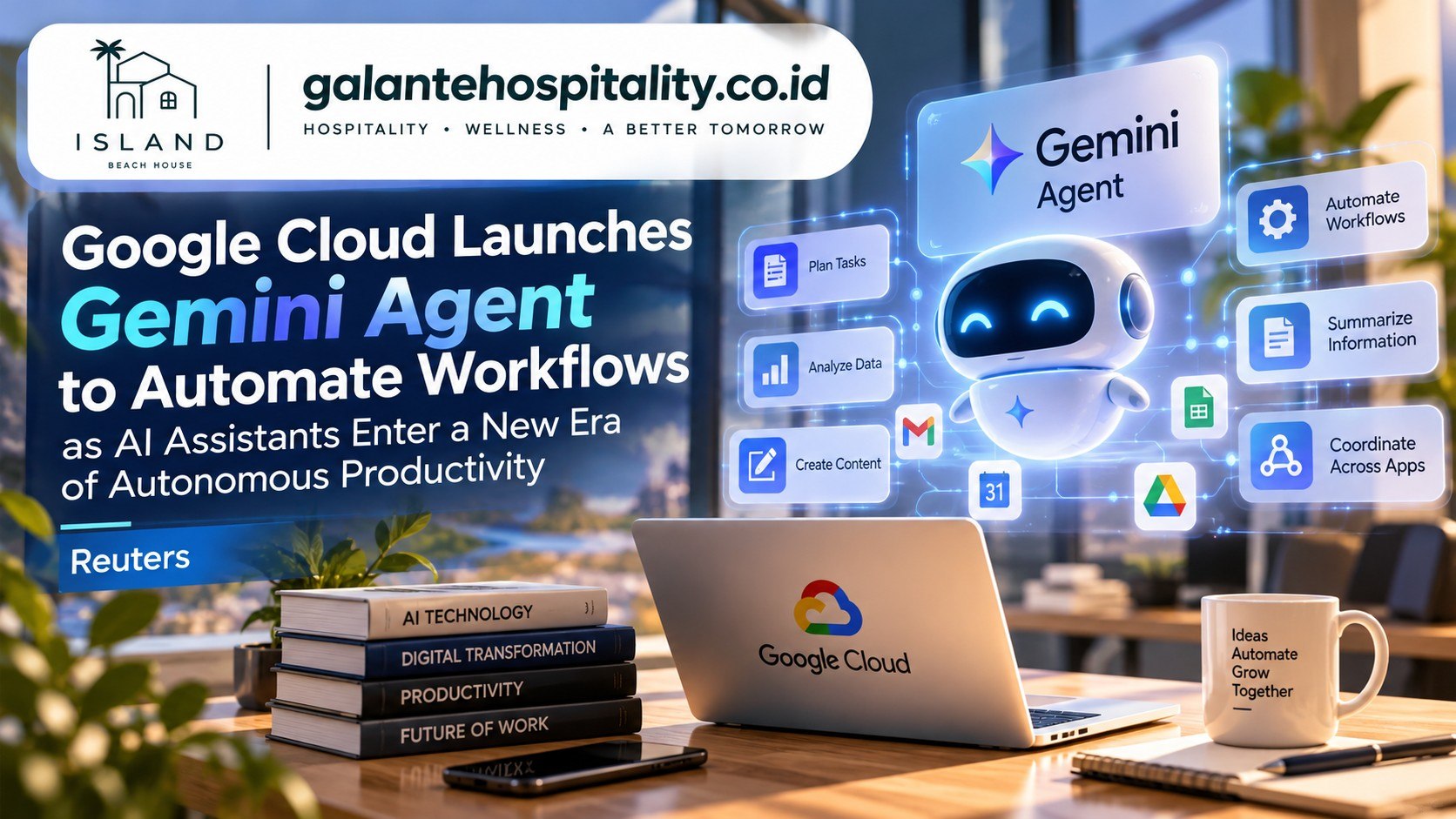

Google Cloud has introduced a new Gemini agent designed to help businesses complete a wide range of workplace tasks through a single artificial intelligence interface.
Announced on October 8, 2026, during the Gemini at Work event, the new system represents Google’s latest move to turn AI assistants into more capable digital workers rather than simple tools for answering questions.
The Gemini agent can answer questions, handle knowledge work, create content and write code. Google also says the agent can plan work, use tools, connect with business systems and return completed work in formats such as documents, emails and development environments. Google Cloud
From AI Chatbots to AI Agents
Traditional AI chatbots are generally designed to respond to individual prompts.
A user asks a question, the system generates an answer, and the interaction ends.
AI agents are designed to take a different approach.
Instead of simply responding to instructions, an agent can break a larger objective into multiple steps and use available tools to complete the task.
For businesses, this could mean asking an AI system to analyze information, prepare a document, organize data and communicate the results without requiring the employee to manually coordinate every step.
Google’s new Gemini agent is designed around this concept.
The company describes it as a universal agent for work that can operate across different business applications and workflows. Google Cloud
Gemini Works Across Google Workspace
One of the most important aspects of the new Gemini agent is its integration with Google Workspace.
The agent can work directly with applications including Gmail, Drive, Docs, Sheets, Slides, Chat and Calendar.
This integration means users can potentially work with information from several applications without repeatedly switching between different AI tools.
For example, an employee could ask Gemini to analyze information stored in spreadsheets, prepare a report in Docs and organize relevant meetings through Calendar.
The objective is to make AI a more integrated part of everyday office workflows.
Support for Microsoft 365 and Slack
Google is also expanding Gemini beyond its own software ecosystem.
According to Reuters, the Gemini agent can be used with Microsoft 365 and Slack in addition to Google’s own Workspace applications. Investing.com
This is particularly important for enterprise customers because large organizations rarely rely on a single software platform.
Companies often use a combination of Google, Microsoft and third-party applications.
An AI agent that can operate across multiple systems could therefore have greater practical value than an assistant restricted to one ecosystem.
Gemini Can Choose Different AI Models
Another interesting feature is the system’s ability to select an appropriate model for different tasks.
The Gemini agent currently uses Google’s Gemini models as well as Anthropic’s Claude models, with additional models expected to be supported later. Investing.com
This reflects a broader trend in enterprise AI.
Businesses may not always want to use one model for every task.
A coding request, a research task, a document analysis project and a creative assignment can have different technical requirements.
A system capable of selecting the appropriate model could potentially improve performance and flexibility.
AI Coworker Agents
Google is also introducing the concept of “coworker agents.”
These agents can act more like digital members of a team, with their own email identity and access limited to the information and systems they are authorized to use.
This concept could change how businesses think about AI assistants.
Instead of viewing AI purely as software, organizations could potentially assign agents specific responsibilities.
One agent could help with research, another could assist with financial analysis and another could support customer service.
However, such systems require strong controls because greater autonomy also creates greater security risks.
Security and Permission Controls
Enterprise AI adoption depends heavily on security.
An AI agent that can access emails, documents, calendars and business systems needs clear restrictions.
Google says its Gemini agent includes identity and policy management, authorization and permission controls, secure sandboxing and network gateways. Google Cloud
These controls are designed to ensure that AI agents can only access information and tools they are authorized to use.
This will become increasingly important as AI systems move from generating information toward performing actions.
AI Agents Could Change Office Productivity
The potential productivity impact is significant.
Employees spend considerable amounts of time moving information between applications, preparing reports, searching through documents and completing repetitive administrative work.
If AI agents can automate some of these activities, employees could spend more time on decision-making, creative work and customer-facing responsibilities.
However, automation will not eliminate the need for human oversight.
Businesses still need employees to verify important decisions, review AI-generated content and ensure that automated actions comply with company policies.
Industry-Specific AI Is Coming
Google is also expanding its AI agent strategy into specialized industries.
Financial services and legal versions are already in preview, while versions for government, healthcare and retail are planned. Investing.com
Industry-specific AI agents could become particularly valuable because different sectors have unique regulations, terminology and workflows.
A legal AI agent, for example, needs different capabilities and safeguards from an agent designed for retail operations.
The Future of AI at Work
The launch of Gemini agent shows that enterprise artificial intelligence is moving into a new phase.
The competition is no longer limited to which company has the best chatbot.
Technology companies are now competing to create AI systems capable of completing entire workflows.
Google’s strategy places Gemini directly in a rapidly developing market alongside competing AI agent platforms.
For businesses, the next challenge will be determining where autonomous AI can deliver real value while maintaining security, accuracy and human oversight.
If these systems mature successfully, AI assistants could evolve from helpful workplace tools into digital collaborators capable of handling increasingly complex responsibilities.


