







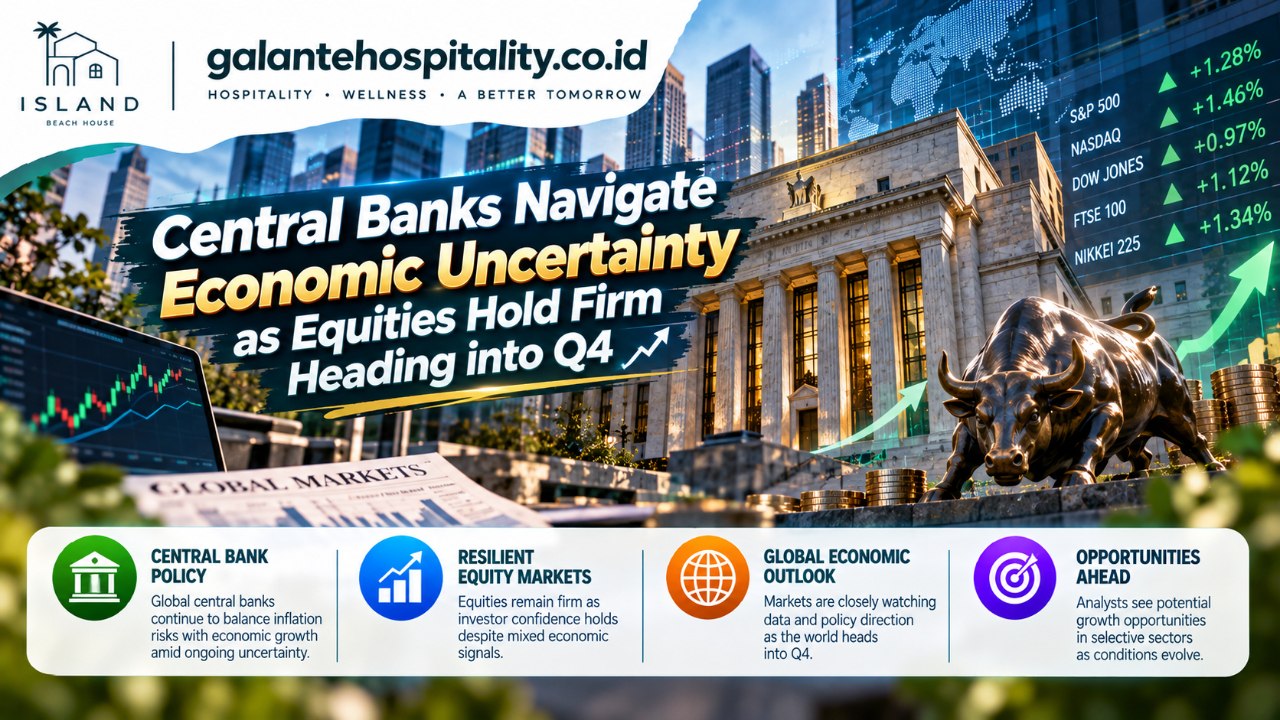

Global financial markets are approaching the final quarter of the year with investors balancing expectations for economic growth against uncertainty surrounding inflation and monetary policy. Equity markets may remain resilient even when interest-rate outlooks are unclear, but the interaction between corporate earnings, borrowing costs, and investor sentiment continues to shape market performance.
Central banks face a difficult balancing act. If interest rates remain high for an extended period, borrowing can become more expensive for households and businesses. Companies may delay investment, consumers may reduce discretionary spending, and sectors that rely heavily on financing can face additional pressure.
On the other hand, lowering rates too quickly when inflation remains persistent could weaken efforts to stabilize prices. Policymakers therefore examine a range of indicators, including inflation reports, employment figures, wage growth, consumer spending, and business activity, before adjusting monetary policy.
Equity markets respond not only to actual policy decisions but also to expectations about future changes. When investors believe borrowing costs may decline without a major deterioration in economic growth, stock prices can receive support. However, if inflation proves more persistent than anticipated, expectations for rate cuts may shift, leading to renewed volatility.
Corporate earnings remain another major influence. Businesses with strong balance sheets, stable demand, and pricing power may be better positioned to navigate uncertain conditions. Companies facing rising input costs or weaker consumer demand may find it more difficult to protect profit margins.
Sector performance can vary considerably. Technology companies may benefit from investment in digital infrastructure and artificial intelligence, although elevated valuations can make some shares sensitive to changing interest-rate expectations. Financial institutions may experience different effects depending on lending activity, funding costs, and credit quality. Consumer-facing businesses are influenced by household purchasing power and confidence.
International developments can also affect market sentiment. Changes in energy prices, currency movements, trade policies, and geopolitical tensions may influence company costs and expectations for global demand. Businesses with international operations can face additional uncertainty when exchange rates or cross-border regulations change.
For investors, a resilient stock market does not necessarily mean that risk has disappeared. Share prices can rise even as economic vulnerabilities remain, particularly when investors anticipate stronger future earnings or more supportive financial conditions. Conversely, temporary declines do not automatically indicate that long-term investment prospects have deteriorated.
A disciplined investment strategy can help reduce the temptation to react to every market headline. Investors should consider diversification, investment time horizons, liquidity requirements, and the relationship between their portfolios and financial goals. Concentrating investments in a small number of companies or sectors can increase exposure to unexpected setbacks.
Regular portfolio reviews can also help determine whether asset allocations still reflect an investor’s circumstances. However, frequent trading based solely on short-term predictions may introduce additional costs and make it harder to maintain a consistent strategy.
As the fourth quarter progresses, inflation releases, central-bank meetings, employment data, and corporate earnings reports are likely to remain important market indicators. Their significance will depend on how the information compares with expectations and what it suggests about future economic conditions.
The outlook remains uncertain, and neither continued equity strength nor an abrupt market decline is guaranteed. Investors who focus on fundamentals, maintain appropriate diversification, and understand the risks associated with their holdings may be better prepared to navigate changing financial conditions.


