







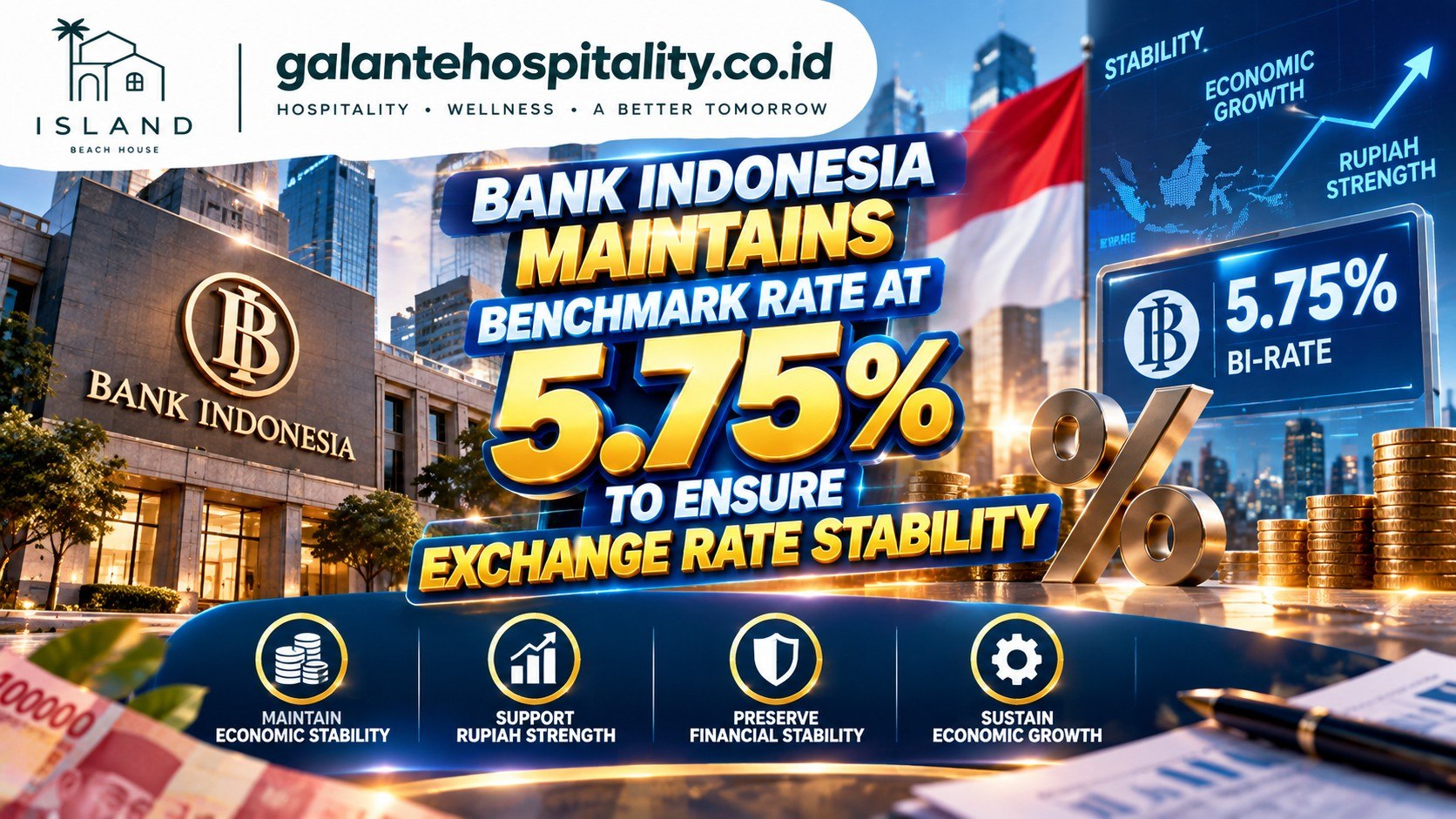

JAKARTA, Indonesia — Following its central Board of Governors Meeting (RDG), Bank Indonesia (BI) announced its decision to maintain the benchmark BI Rate at 5.75%. Correspondingly, the central bank kept the Deposit Facility rate at 4.75% and the Lending Facility rate at 6.50%.
Monetary policy decision-makers highlighted that keeping interest rates unchanged is a pro-stability measure intended to safeguard the domestic currency, manage foreign inflation risks, and preserve steady national economic growth.
https://encrypted-tbn3.gstatic.com/licensed-image?q=tbn:ANd9GcShnI9LV8rWjSOQd-E2XT12Ys8_FBkBkMU-1bnzy6wZ-78nIgz-8Bn1LuPyQdOJ-1h3tfytENfrvgx_FEw
Alt Text: Bank Indonesia exterior facade in Jakarta representing central banking monetary policy decision
1. Strategic Rationale Behind the Rate Hold
Bank Indonesia’s decision reflects a calculated balancing act between external financial volatility and domestic growth targets.
+-------------------------------------------------------------------+
|                  BANK INDONESIA KEY POLICY RATES                  |
+-------------------------------------------------------------------+
| Policy Metric                     | Rate (%)                      |
+-----------------------------------+-------------------------------+
| Benchmark BI Rate                 | 5.75%                         |
| Deposit Facility Rate             | 4.75%                         |
| Lending Facility Rate             | 6.50%                         |
| Inflation Target Corridor         | 2.5% ± 1%                     |
+-----------------------------------+-------------------------------+
Primary Objectives of the Policy:
- Exchange Rate Stabilization: Defending the Indonesian Rupiah (IDR) against high benchmark yields in foreign bond markets and global currency shifts.
- Controlling Imported Inflation: Preventing higher import costs from raising local food, energy, and manufacturing prices.
- Sustaining Domestic Liquidity: Providing commercial banks with a predictable rate environment to support private enterprise credit expansion.
2. Navigating Global Financial Volatility
The central bank’s stance is largely shaped by shifting macroeconomic trends in major economies. With prolonged high interest rates set by international central banks and elevated geopolitical uncertainty, emerging market assets face constant risk of capital outflows.
             Global Market Volatility & Capital Shifts
                                |
                                v
               Bank Indonesia Pro-Stability Policy
                                |
     +--------------------------+--------------------------+
     |                                                     |
     v                                                     v
[Rupiah Exchange Defense]                     [Domestic Inflation Control]
Interventions in spot & DNDF                  Anchoring consumer inflation
money markets                                 within the 2.5% ± 1% corridor
To counter these pressures, Bank Indonesia continues to utilize its full monetary toolkit:
- Direct market interventions in the spot foreign exchange and Domestic Non-Deliverable Forward (DNDF) markets.
- Issuance of Bank Indonesia Rupiah Securities (SRBI) to attract foreign portfolio investments.
- Coordinating fiscal and monetary strategies closely with the Ministry of Finance.
Related External Link:Review Bank Indonesia Official Monetary Policy Reports(Outbound Link Suggestion)
3. Macroprudential Incentives to Drive Economic Growth
While maintaining a pro-stability monetary stance, Bank Indonesia is simultaneously deploying pro-growth macroprudential policies to prevent a slowdown in domestic lending.
Under the Macroprudential Liquidity Incentive Policy (KLM), commercial banks that direct credit toward key sustainable sectors—such as renewable energy, downstream manufacturing, affordable housing, and agricultural production—receive liquidity reserve incentives from BI. This approach ensures that strict benchmark rates do not choke off credit flow to essential domestic industries.
4. Market Outlook and Economic Forecasts
Financial analysts and banking economists have widely praised BI’s conservative hold decision. Market sentiment indicates that maintaining the 5.75% benchmark rate instills confidence among corporate borrowers and portfolio managers alike.
Looking forward, Bank Indonesia projected that national GDP growth will remain firmly within the 4.7% to 5.5% range, supported by domestic consumption, robust state investment, and stable financial sector fundamentals.


