







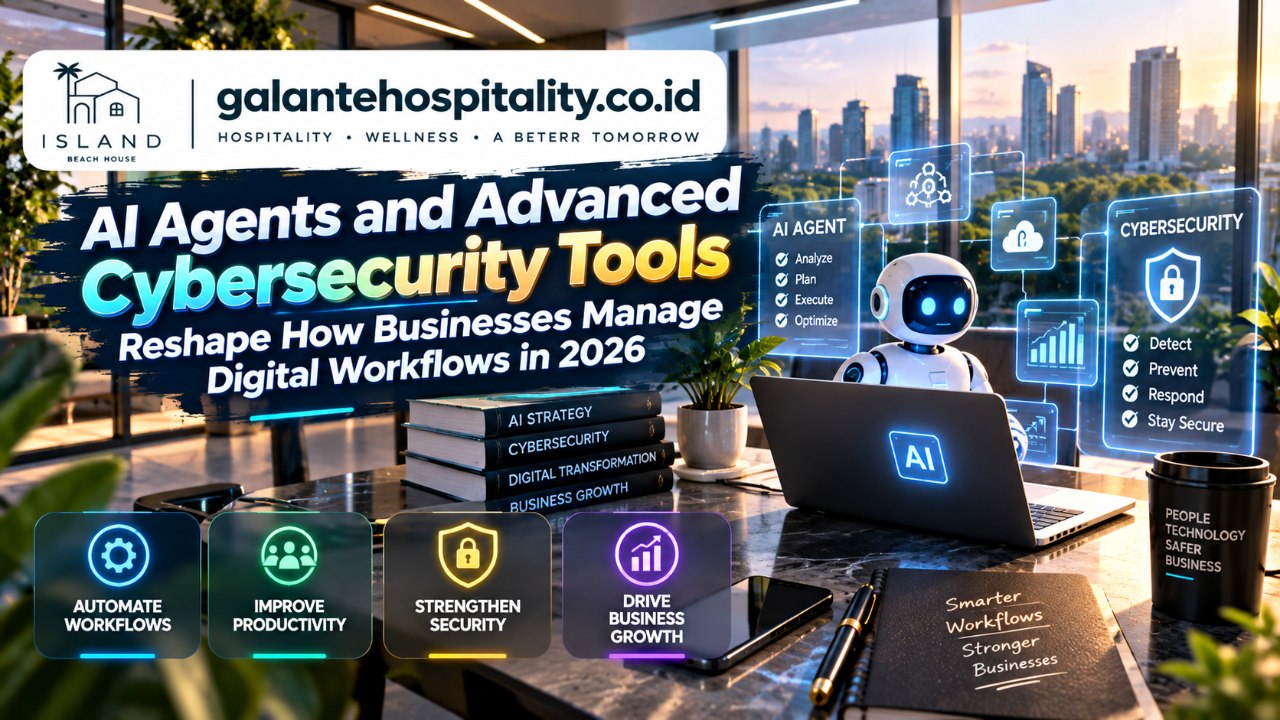

Artificial intelligence is moving beyond tools that simply answer questions or generate content. Businesses are increasingly exploring AI agents that can perform multi-step tasks, interact with software applications, and support complex digital workflows.
This development creates new opportunities for productivity, but it also introduces security challenges. As AI agents gain access to company systems and information, organizations must understand what these tools can do, which permissions they need, and how their activities should be monitored.
Recent industry guidance has highlighted the risks associated with AI agents being adopted without adequate oversight. Gartner, for example, discussed the growing problem of unmonitored or unauthorized AI agents in its September 30, 2026, analysis of agentic AI governance.
AI Agents Are Changing Workplace Automation
Traditional automation generally follows predefined rules. An automated process might transfer information between applications or send a notification when a particular condition is met.
AI agents can work in a more flexible way. Depending on their design and permissions, they may interpret a goal, identify relevant information, use connected tools, and complete several related steps.
For example, an agent supporting a sales team could summarize customer interactions, organize follow-up tasks, and prepare a draft response. A software development agent might review code, identify potential problems, and suggest changes for a developer to examine.
These capabilities can reduce repetitive work and allow employees to focus on decisions requiring human judgment.
However, the level of autonomy varies considerably between products. Some systems only recommend actions, while others can execute approved operations within connected applications.
Productivity Must Be Balanced With Security
Giving an AI agent access to business tools can create risks if permissions are poorly designed.
An agent connected to email, cloud storage, customer records, or internal systems may encounter confidential information. If its access is broader than necessary, an error or malicious instruction could expose data or trigger an unintended action.
Businesses should therefore apply the principle of least privilege: each agent should receive only the permissions needed for its assigned responsibilities.
Sensitive operations should also require appropriate approval. For example, an agent might prepare a payment request or draft a customer account change, while a human employee must approve the final action.
This approach helps organizations benefit from automation without treating AI-generated decisions as automatically trustworthy.
The Rise of Unmonitored AI Tools
One emerging concern is the use of AI agents outside formal company governance.
Employees may create their own automated workflows or connect AI tools to workplace applications without informing the IT or security team. These systems can become difficult to track, especially when they operate across multiple platforms.
Gartner has described these unmonitored systems as part of the broader problem of shadow AI. Without clear visibility, organizations may struggle to determine what information agents can access, which actions they perform, or who is responsible when something goes wrong.
Businesses can address this challenge by establishing approved tools, maintaining an inventory of active agents, and creating clear procedures for requesting new integrations.
The goal should not necessarily be to prohibit every experiment. Instead, organizations need a framework that allows useful innovation while maintaining appropriate controls.
Cybersecurity Teams Need Better Visibility
As AI agents become more integrated into business systems, security teams need to monitor both traditional users and automated identities.
This includes understanding which applications an agent can access, which credentials it uses, and what actions it performs.
Organizations should maintain activity logs and use alerts to identify unusual behavior. An agent that suddenly attempts to access unrelated files or perform an unexpected sequence of actions may require investigation.
Regular testing is also important. Businesses can simulate common failure scenarios to determine whether an agent follows its assigned boundaries and whether protective controls respond appropriately.
Security measures should be designed around the potential impact of each agent rather than applying the same restrictions to every workflow.
Human Oversight Remains Essential
AI agents can make mistakes, misunderstand instructions, or produce outputs based on incomplete information. These limitations become more significant when systems are allowed to act without human review.
A practical approach is to classify tasks by risk.
Low-risk activities, such as organizing non-sensitive information, may be suitable for greater automation. Higher-risk actions involving financial transactions, confidential records, legal commitments, or access permissions should receive stronger supervision.
Human oversight should be meaningful rather than symbolic. Employees need enough information to understand the proposed action and the ability to reject or reverse it when appropriate.
Clear accountability also matters. Organizations must identify who owns an agent, who reviews its performance, and who responds when it behaves unexpectedly.
Building Responsible AI Workflows
Companies planning to adopt AI agents should begin by identifying repetitive processes that have clear objectives and measurable outcomes.
A small pilot project can help teams assess accuracy, time savings, security requirements, and user experience before expanding the technology.
Organizations should also document acceptable uses, establish data-handling rules, and train employees to recognize potential risks. Security teams, IT departments, legal specialists, and business leaders may need to collaborate when an agent interacts with sensitive systems.
Regular reviews are necessary because an agent’s behavior and permissions may change as its underlying model, connected applications, or assigned tasks evolve.
The Future of Enterprise AI
AI agents could become an important part of digital work, particularly where employees regularly move between applications and handle repetitive information-processing tasks.
Yet successful adoption will depend on more than the ability to automate work. Businesses will need reliable governance, clear accountability, appropriate security controls, and realistic expectations about what AI systems can accomplish.
Organizations that combine useful automation with careful oversight will be better positioned to capture productivity benefits while limiting unnecessary risk.
In 2026, the central challenge is no longer simply whether businesses should experiment with AI agents. It is how they can deploy these systems responsibly, measure their value, and maintain control as automation becomes more deeply embedded in everyday operations.


