







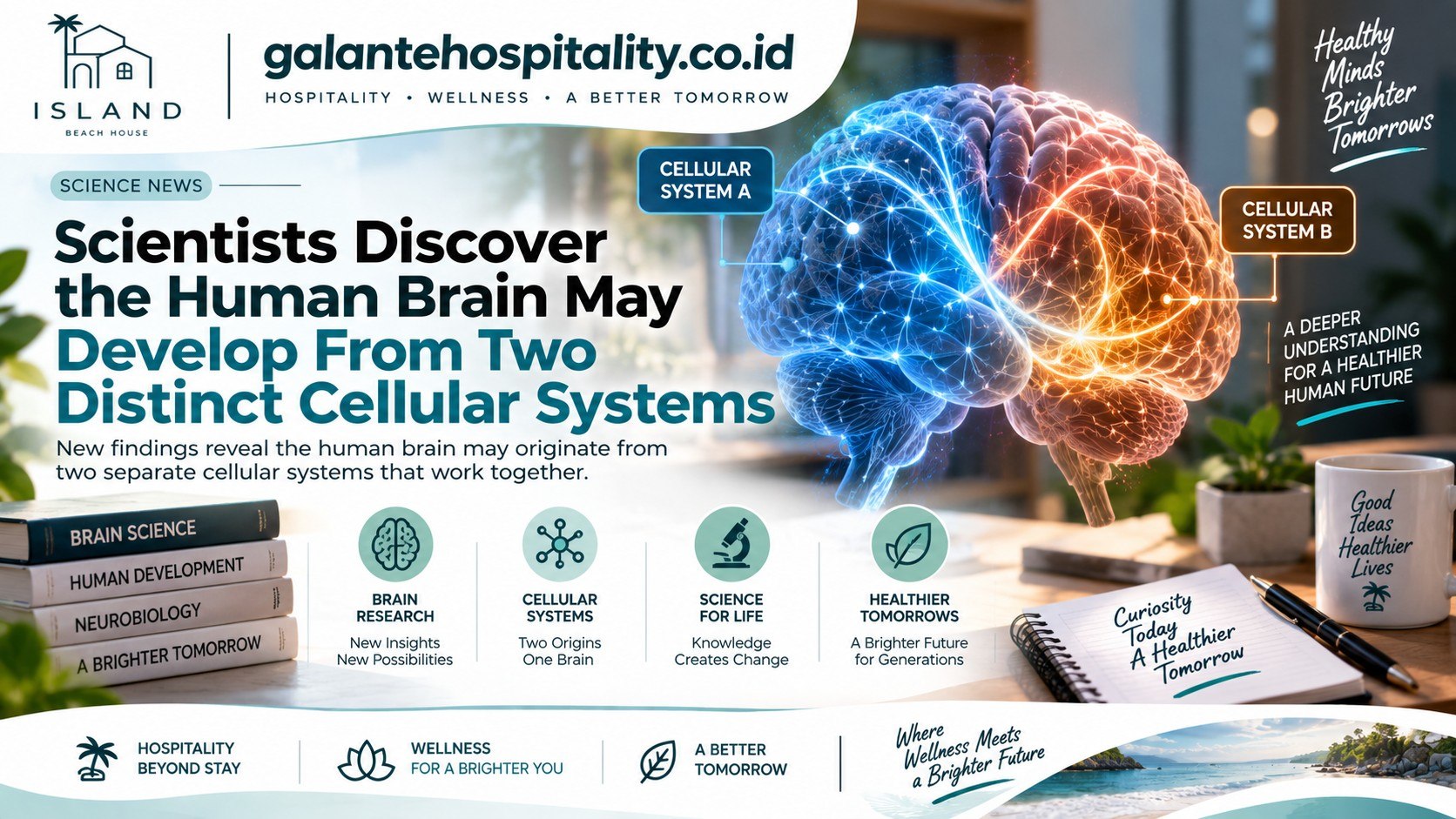

Scientists Uncover a New Clue About Brain Development
Scientists have discovered evidence that challenges the traditional understanding of how the human brain develops.
A Stanford Medicine-led study published in Nature Neuroscience found that different regions of the brain arise from two distinct populations of early developmental cells, known as progenitor cells.
The research suggests that the forebrain and midbrain develop from one cellular population, while the hindbrain follows a separate developmental pathway.
This does not mean that adults have two physically separate brains. Instead, the finding describes two distinct developmental origins that eventually form one connected brain.
Two Cellular Pathways Develop in Parallel
Researchers studied early embryonic development to understand where different parts of the brain originate.
One group of progenitor cells expresses a gene called Otx2 and contributes to the development of the forebrain and midbrain. Another group expresses Gbx2 and develops into the hindbrain.
The researchers found that these populations remain distinct during early development rather than beginning from one common progenitor population.
The discovery provides a different perspective on a developmental process that scientists have studied for decades.
Different Brain Regions Have Different Roles
The forebrain is associated with many complex functions, including language, consciousness and abstract reasoning.
The hindbrain, meanwhile, plays an important role in essential functions such as breathing, heartbeat regulation, swallowing and other automatic processes.
Understanding that these areas have different developmental origins could help scientists better understand why certain brain cells are difficult to produce in laboratory settings.
Researchers Successfully Grow Hindbrain Neurons
One of the most significant results of the research was the ability to guide human pluripotent stem cells into functional hindbrain motor neurons.
The cells demonstrated characteristics associated with genuine hindbrain neurons, including electrical activity and proteins linked to specific functions.
This achievement could provide researchers with a new laboratory model for studying cells that are otherwise difficult to obtain from living human patients.
Potential Implications for Neurological Diseases
The discovery could be particularly useful for research into neurological diseases affecting the brainstem.
Researchers highlighted conditions such as spinal muscular atrophy, or SMA, and amyotrophic lateral sclerosis, commonly known as ALS.
Both diseases can affect neurons associated with the hindbrain. Having a way to grow relevant human neurons in the laboratory could allow scientists to study how these cells become damaged and potentially test future treatments.
The researchers emphasized that the work is a foundation for further investigation rather than an immediate treatment for these diseases.
The Finding May Also Explain Earlier Research Challenges
Scientists have previously struggled to create certain types of hindbrain neurons in the laboratory.
The new developmental model offers a possible explanation: researchers may have been attempting to transform progenitor cells that were already committed to a different developmental pathway.
By understanding the process from its earliest stages, scientists can potentially guide stem cells toward the correct cellular identity more effectively.
A New Perspective on Brain Evolution
The researchers also examined evolutionary evidence and found similar developmental patterns across species, suggesting that the separation between these neural systems may have deep evolutionary roots.
Their findings point toward the possibility that ancient nervous systems with different functions were brought together during evolution and eventually formed the integrated brain found in modern vertebrates.
More Research Could Follow
The discovery provides scientists with a new framework for studying brain development and neurological disease.
Researchers now hope to investigate other parts of the nervous system and determine how diseases affect neurons that originate through these different developmental pathways.
Although much more research is needed, understanding the cellular origins of the brain could eventually improve laboratory models and provide new opportunities for studying complex neurological disorders.


